
Birth Chart Synastry
Synastry is the astrological practice of comparing two birth charts to explore a relationship. Enter both people’s birth dates and, if you know them, birth times and UTC offsets. The calculator works out where the Sun, Moon and planets were for each person and lists the aspects between the two charts — the angles astrologers read as harmony or tension — with their traditional meanings.
- Instant download
- Editable Excel & Word
- Print-ready PDF
- 7-day refund
5 files · PDF, XLSX, DOCX
Synastry Worksheet Pack
Printable synastry workbook: two blank zodiac chart wheels, a planet-by-planet synastry aspect grid, a signs, elements and aspects reference sheet, and a relationship reflection worksheet.
- Chart wheel — person A (PDF)
- Chart wheel — person B (PDF)
- Aspect grid (PDF/XLSX)
- + 2 more
$5.00 USD, one-time 5 files · about $1.00 each
- Instant download
- 7-day refund
- Secure checkout by Stripe
7-day money-back guarantee. Full refund within 7 days of purchase, even after you download.
Free sample: Zodiac Chart Wheel A (PDF, 134 KB)
Synastry Worksheet Pack
Printable synastry workbook: two blank zodiac chart wheels, a planet-by-planet synastry aspect grid, a signs, elements and aspects reference sheet, and a relationship reflection worksheet.
- Chart wheel — person A (PDF)
- Chart wheel — person B (PDF)
- Aspect grid (PDF/XLSX)
- Reference sheet (PDF)
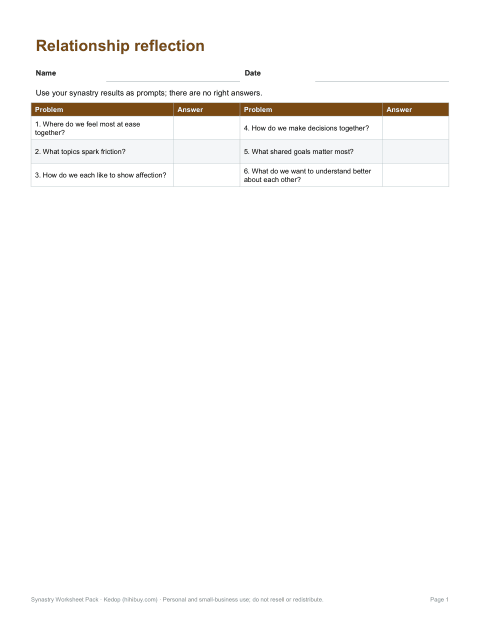
- Reflection worksheet (PDF, DOCX)
Formats: PDF, XLSX, DOCX. Instant download after payment (link valid 72 hours, up to 5 downloads). AI-assisted: the templates were drafted with AI help and reviewed and laid out before publishing.
$5.00 USD, one-time 5 files · about $1.00 each
- Instant download
- 7-day refund
- Secure checkout by Stripe
7-day money-back guarantee. Full refund within 7 days of purchase, even after you download.
Free sample: Zodiac Chart Wheel A (PDF, 134 KB)
Full refund within 7 days — see the refund policy and license.
Free printables
Single sheets you can print right now, no sign-up. The full pack adds every sheet in one download plus the editable files.
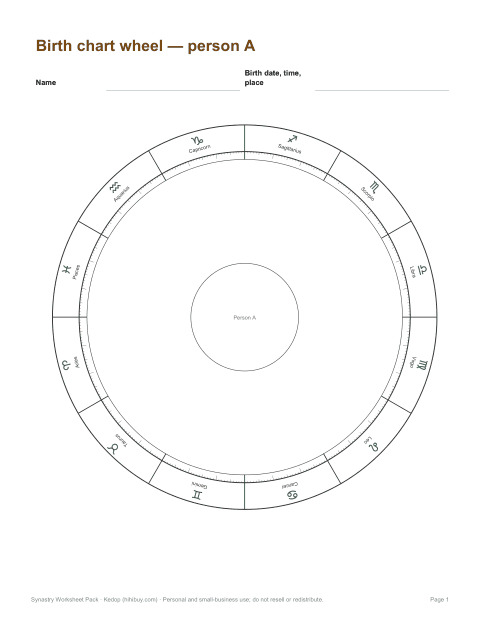
 Printable Birth Chart Wheel for Person A
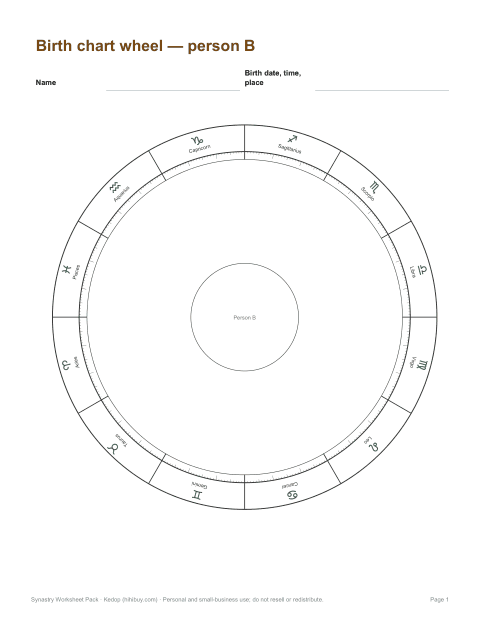
 Printable Synastry Chart Wheel for Person B
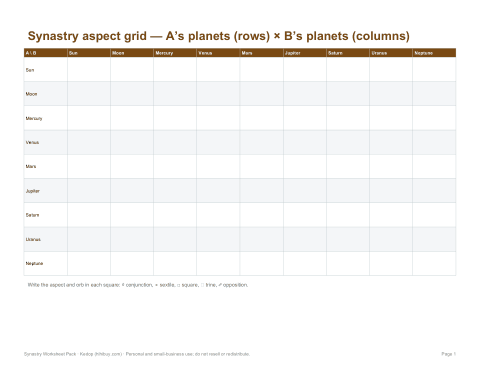
 Printable Synastry Aspect Grid
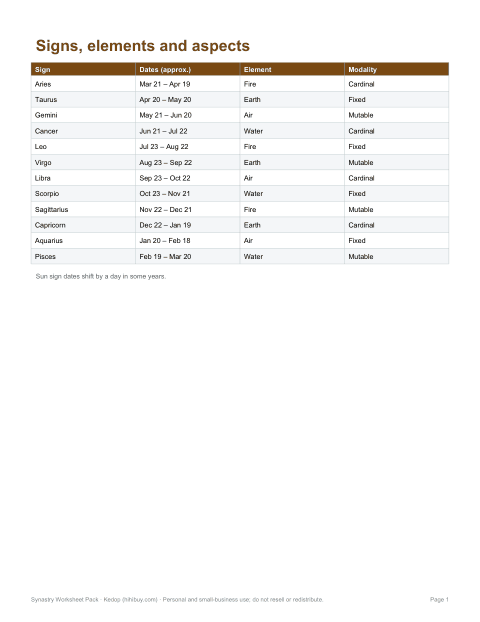
 Printable Synastry Reference Sheet
 Printable Synastry Reflection Worksheet
Synastry calculator
What synastry is
In astrology, a birth chart is a map of where the Sun, Moon and planets appeared along the zodiac at the moment someone was born. Synastry lays two charts side by side and looks at the angles, called aspects, between one person’s planets and the other’s. Astrologers read close aspects as points of connection: some suggest ease and shared understanding, others friction or strong attraction. It is a tradition of symbolism and self-reflection, not a scientific method — no controlled study has shown that astrology predicts compatibility — so treat the results as a conversation starter rather than a verdict.
How the positions are calculated
The calculator computes real astronomical positions. Planet positions come from the approximate orbital elements published by NASA’s Jet Propulsion Laboratory for the years 1800–2050, and the Moon’s position uses the main terms of Jean Meeus’s lunar theory. Checked against known events — such as the Jupiter–Saturn conjunction of December 2020 and the 2024 total solar eclipse — the positions agree to within about a tenth of a degree, which is ample for working out signs and aspects. Signs use the tropical zodiac, as in most Western astrology.
The major aspects
| Aspect | Angle | Typical orb | Traditional reading |
|---|---|---|---|
| Conjunction | 0° | ±8° | Energies blend and intensify |
| Sextile | 60° | ±4° | Easy cooperation and opportunity |
| Square | 90° | ±6° | Tension that pushes growth |
| Trine | 120° | ±6° | Natural harmony and flow |
| Opposition | 180° | ±8° | Attraction of opposites; balance needed |
The orb is how far from the exact angle an aspect can be and still count. Tighter orbs mean stronger aspects in traditional practice. The calculator uses slightly smaller orbs for aspects that don’t involve the Sun or Moon, and you can switch between tight, standard and wide orbs.
Why birth time matters
The Moon moves about 13 degrees a day, so without a birth time its position can be uncertain by up to about 6–7 degrees either side of the noon estimate — sometimes enough to change its sign. The other planets move much more slowly, so the date alone is usually enough for them. The rising sign (ascendant) and houses need an exact time and place, so they are not included here. Enter the UTC offset that applied at birth: for example −5 for US Eastern Standard Time or −4 during daylight saving time.
Aspects commonly highlighted in synastry
- Sun–Moon contacts, especially conjunctions and trines, are traditionally seen as a sign of mutual understanding.
- Venus–Mars aspects are associated with romantic and physical attraction.
- Moon–Moon harmony suggests similar emotional needs.
- Mercury aspects describe how easily two people talk and think together.
- Saturn contacts are linked with commitment and responsibility — and with feeling restricted.
- Squares and oppositions are not “bad”: many long relationships have them; they point to areas that need understanding.
Worked example
With the sample dates, Alex (born 18 April 1992) has the Sun in Aries, and Jamie (born 2 November 1990) has the Sun in Scorpio. The calculator lists each person’s planet signs, then every aspect between the two charts within the chosen orbs, tightest first, and counts how many are harmonious (trines and sextiles) and how many challenging (squares and oppositions). Because Jamie’s birth time is unknown, the Moon is marked as approximate.
Using the printable worksheet
The template pack includes a blank zodiac chart wheel for each person, an aspect grid to fill in, a reference sheet of signs, elements and modalities, and a reflection worksheet with questions to discuss together. They are designed for workshops, journaling and astrology study groups.
A balanced view
Use synastry for curiosity and conversation. Real relationships depend on communication, shared values, respect and effort — things no chart can measure. If you are making important decisions, rely on your own judgement and, where appropriate, professional advice.
Privacy
Birth details are processed in your browser only; nothing is uploaded or stored.
Frequently asked questions
What is synastry in astrology?
Comparing two birth charts to look at the aspects between one person’s planets and the other’s.
Do I need a birth time?
It helps for the Moon; the other planets are accurate from the date alone.
What is an orb?
The allowed distance from an exact aspect angle, such as ±6° for a trine.
Which aspects are considered harmonious?
Trines and sextiles, and often conjunctions depending on the planets.
Is astrology scientifically proven?
No, studies have not shown astrology predicts personality or compatibility; use it for reflection and fun.
Are my birth details stored?
No, everything runs in your browser.